


Prayer Plant: care guide for the Maranta Leuconeura
Few houseplants narrate their day quite like the Prayer Plant. At dawn, its velvety foliage stretches out flat to capture every bit of light. As evening sets in, the leaves slowly rise and fold upward like a cupped pair of hands, a movement that earned the plant its names: Prayer Plant, or Sleeping Plant. Native to the shaded floors of Brazilian rainforests, this small ground-covering plant thrives where light stays gentle and the air remains slightly humid, making it an excellent companion for the shadier corners of our homes.
This guide gathers everything you need to keep yours vivid, upright and healthy: ideal exposure, watering frequency, humidity, the most common issues (brown tips, curled leaves, spider mites), maintenance routine, and how to propagate by division.

Contents
- The essentials in 30 seconds
- Prayer Plant: portrait of foliage that changes posture between day and night
- Ideal indoor conditions
- Which soil and which pot to choose
- Common problems and solutions
- Pests: spider mites first, more rarely thrips and mealybugs
- Maintenance routine and longevity
- How to propagate a Prayer Plant: clump division
- Prayer Plant and pets
- Adopt your Prayer Plant
- FAQ Prayer Plant
The essentials in 30 seconds
| Latin name | Maranta leuconeura (signature variety: "Erythroneura", also known as "Tricolor") |
| Other names | Prayer Plant, Sleeping Plant, Praying Hands, Rabbit's Tracks |
| Family | Marantaceae |
| Origin | Tropical rainforests of Brazil |
| Light | Gentle, indirect light, tolerates partial shade |
| Watering | Once a week in spring and summer, every 10 to 15 days in autumn and winter |
| Humidity | Ideally 50% to 70%, never below 40% |
| Temperature | 18 to 27 °C year-round, away from cold draughts |
| Adult size indoors | 30 to 40 cm tall, spreading ground-cover habit |
| Difficulty | Beginner |
| Toxicity | Non-toxic to cats, dogs and children (listed by the ASPCA) |
| Signature | Nyctinasty: leaves fold upright every night |
Prayer Plant: portrait of foliage that changes posture between day and night
The Maranta leuconeura grows wild on the shaded floors of Brazilian rainforests, spreading as a low carpet beneath the canopy. Its name honours Bartolomeo Maranta, a 16th-century Italian physician and botanist, while leuconeura refers to the pale veins that trace each oval leaf.
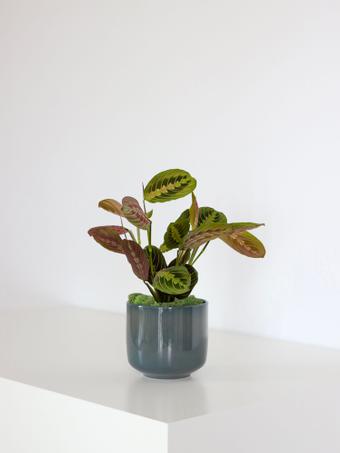
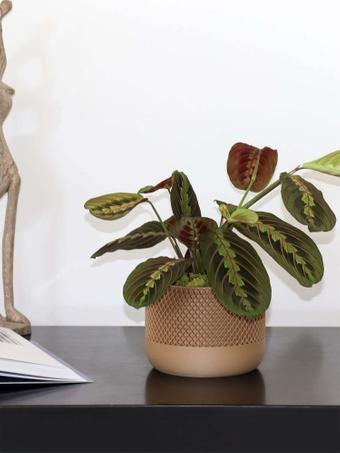
The most popular variety for indoor growing, and the one we offer at Léon & George, is the Erythroneura, more often called Tricolor: light to deep green leaves marked with a cream blotch along the central vein and crossed by raspberry-red veins that look hand-painted. The underside of each leaf is a clear purple, which adds even more colour when the plant rises at dusk.
Its true signature is the daily movement botanists call nyctinasty: at sunset, motor cells located at the base of each leaf (the pulvini) lose their water pressure, and the blades pivot upward like two hands joining in prayer. At dawn the movement reverses and the plant settles flat again. This is no decorative quirk: it limits nighttime evaporation and maximises the leaf surface that catches daytime light.
A happy Prayer Plant may even produce tiny, fleeting white bell-shaped flowers, modest but charming, appearing now and then through spring and summer.
Ideal indoor conditions
Light: gentle, indirect, never in direct sun
The Prayer Plant is an understory dweller. It thrives in a bright but never sunlit spot: about one to two metres from an east- or north-facing window, or pulled back from a south-facing window filtered by a sheer curtain. It is one of the few houseplants that also handles shadier corners, which makes it an excellent pick for a bathroom with a skylight, a hallway, or a tucked-away corner. By contrast, direct sun bleaches its foliage, browns the edges and washes out its signature markings.
For the best spot, see our collection of plants for shaded locations.
Watering: consistent but never excessive
The Prayer Plant likes a substrate that is always slightly moist but never waterlogged. Aim for one watering a week in spring and summer, then stretch to every 10 to 15 days in autumn and winter. The golden rule: before each watering, push a finger into the soil down to 2 or 3 cm. If it still feels damp, wait a few more days.
Use soft, room-temperature water. The Prayer Plant is sensitive to chlorine and limescale, which quickly show up as brown leaf tips. Reach for rainwater, filtered water, or let tap water stand for 24 hours in an open container so the chlorine can evaporate.
Remember to empty the saucer or the bottom of the cachepot ten minutes after watering: Prayer Plant roots cannot sit in water.
Humidity: high ambient moisture, non-negotiable
This is where the health of your Prayer Plant is won or lost. It needs 50% to 70% ambient humidity, and clearly suffers below 40% (brown tips, curling leaves). Three reliable habits:
- mist the foliage with soft water two or three times a week, ideally in the morning so it dries before nightfall;
- group the Prayer Plant with other green plants: they create a more humid microclimate;
- in winter, move the plant away from radiators and consider a room humidifier if the air is very dry.
For a focused boost, you can spray your foliage with our Brume Magique.
Temperature: stable, no cold draughts
Keep the temperature between 18 and 27 °C year-round. Sudden cold is its worst enemy: avoid windowsills in winter, drafty entrance halls, and the immediate vicinity of doors that open often. At the other extreme, a winter radiator running full blast will weaken it just as fast as a cold draught.
Fertilising: a boost during the growing season
From April to September, feed with a liquid houseplant fertiliser diluted by half, once a month. The Prayer Plant is a modest grower that does not need heavy feeding: too much fertiliser burns its fine roots and damages the foliage. In autumn and winter, suspend feeding entirely: the plant enters its slow-growth season.
Which soil and which pot to choose
The Prayer Plant enjoys a light, organic-rich, well-draining substrate. A balanced mix works perfectly: a houseplant potting soil amended with roughly a quarter of coco coir or peat moss, plus a handful of perlite or pumice to aerate the root ball. The goal: hold moisture without ever forming a pocket of stagnant water.
For the container, go for a nursery pot with drainage holes, slightly wider than the root ball (a 2 to 3 cm margin on each side is enough). The Prayer Plant has a shallow but spreading root system, so a pot that is wider than it is tall suits it better. Slip that nursery pot into a ceramic, brushed-aluminium or coloured-glass cachepot, whatever you like. If your cachepot has no drainage, add a layer of clay pebbles at the bottom to keep the roots away from residual moisture.
Common problems and solutions
The Prayer Plant is expressive: its foliage announces its needs right away. Here are the most common signals, ordered by frequency.
Yellow, limp leaves: overwatering is the prime suspect
On a Prayer Plant, yellowing almost always starts at the base and is paired with leaves that turn soft. The prime suspect: a substrate that has stayed soaked for too long, suffocating the plant's fine root system. Before reaching for the watering can, get into the habit of checking moisture in the top 2 to 3 cm of soil first.

The soil stays soaked: overwatering. If several leaves yellow at the same time and the substrate gives off a musty smell, stop watering. Slide the plant out of its nursery pot, inspect the roots, snip away the black mushy sections with a disinfected pair of secateurs, then repot in fresh, well-draining soil.
A few scattered yellow leaves on an otherwise thriving plant. No alarm: the Prayer Plant naturally turns over its foliage, and the older leaves eventually yellow and drop. Cut them off at the base with disinfected secateurs.
Water too hard or too chlorinated. Gradual yellowing accompanied by brown leaf tips often points to unsuitable tap water. Switch to rainwater, filtered water, or let tap water stand 24 hours before use.
Leaves curled into cones or sagging: the plant is thirsty

When the leaves of a Prayer Plant stay curled during the day instead of opening flat, or droop limp around the rim of the pot, two leads to follow: the root ball has dried out at depth, or the ambient air has turned too dry. Plunge the nursery pot into a basin of lukewarm water for about ten minutes to rehydrate the whole root ball, then let it drain thoroughly. Resume a regular watering schedule without letting the substrate dry out fully between sessions, and mist the foliage two or three times a week.
Brown, dry leaf tips: air too dry or hard water
Tips that brown and turn brittle to the touch are the most frequent signal on the Prayer Plant. Three causes, ordered by frequency: ambient humidity is too low (below 40%), watering water is too hard or chlorinated, or the plant is sitting in a dry draught (radiator, air conditioning). Mist the foliage more often, switch to soft water, and move the plant away from sources of dry heat. Trim the brown areas with disinfected scissors, following the curve of the leaf to keep its outline neat.
Faded markings or washed-out foliage: revisit the exposure
The contrast between the green and the raspberry-red veins fades most often because of exposure that is too bright (direct sun bleaching it out) or, conversely, prolonged low light. Reposition the plant to a bright but filtered spot: the colours will return on the new leaves over the weeks that follow.
Pests: spider mites first, more rarely thrips and mealybugs
The Prayer Plant is not a particularly fragile species, but its tender foliage and need for humidity make it an easy target for spider mites, by far the number-one pest on this plant. Dry winter air plus sap-rich tissue: ideal conditions for an infestation to take hold within a few weeks.
How to spot them? On the underside of the leaves, fine webbing between the veins, yellow or silvery stippling on the leaf surface, and tiny red or black moving dots. If the infestation is advanced, leaves drop one after another.
How to act? Shower the plant immediately under lukewarm water from the showerhead, paying special attention to the undersides. Then treat with Super Neem Oil or with a solution of L'Original black soap, one application every 5 to 7 days for three weeks to break the reproduction cycle. Permanently raise ambient humidity to prevent a recurrence.
Occasionally, the Prayer Plant can also host mealybugs (white cottony clumps in the leaf axils) or thrips. Black soap and neem oil treatments work for all three.
Maintenance routine and longevity
Pruning: minimal upkeep
The Prayer Plant is never pruned to shape it: its naturally spreading, ground-cover habit is exactly what you want. Maintenance comes down to a few simple grooming gestures.
In practice, remove dried or damaged leaves at the base of the petiole with disinfected secateurs or scissors. If only the tips are dry, trim them following the curve of the leaf rather than sacrificing the whole blade. Avoid removing more than a third of the foliage at once, especially in winter when the plant is in slow growth.

Foliage cleaning: for consistently vivid colours
The Prayer Plant's velvety leaves collect dust quickly, which slows photosynthesis and dulls the contrasts. Once a month, gently wipe each side with a soft, slightly damp cloth. For a deeper clean, add a drop of L'Original black soap diluted in a glass of water, then wipe clean with plain water. Use the moment to inspect the leaf undersides for pests.
Rotating the pot
The Prayer Plant naturally seeks light. To stop it from leaning to one side, give the pot a quarter turn at each watering. You will end up with a balanced plant that fills out evenly.
Top-dressing and repotting
The Prayer Plant likes a repot every 2 to 3 years, in early spring, when the roots start spiralling against the walls of the pot. Pick a new nursery pot with drainage, slightly wider (2 to 3 cm of extra diameter is enough), refill with fresh substrate (houseplant soil amended with perlite), and water generously after the operation. Allow two to four weeks before the plant resumes visible growth.
If you would rather it not grow any larger, stick to an annual top-dressing: gently scrape away the top 3 cm of surface soil and replace with fresh, organic-rich substrate.
How to propagate a Prayer Plant: clump division
The Prayer Plant can be multiplied two ways, and division remains the simplest and most reliable.
Clump division (spring). During a repot, gently slide the plant out of its pot and look at the base: you will see several clumps connected by short rhizomes. With your fingers, or if necessary with disinfected secateurs, separate two or three sections, making sure each one has healthy roots and at least three or four leaves. Pot each division immediately in a small drainage pot filled with fresh substrate. Water moderately, place in bright shade, and wait: recovery is usually visible within two to three weeks.
Stem cuttings in water (spring and summer). Take a healthy stem about 10 cm long carrying two or three leaves, cutting just below a node. Place the cutting in a glass of soft water in bright but indirect light, and change the water every 3 to 4 days. The first roots appear in 3 to 4 weeks. When they reach 3 to 5 cm, transfer the cutting into a pot with a light substrate, keeping the soil consistently moist for the first few weeks.
Prayer Plant and pets
Good news for homes with dogs, cats or young children: the Maranta leuconeura is officially listed as non-toxic by the ASPCA, the American reference body on plant toxicity. You can place it in a living room without worrying about a clumsy encounter with your four-legged companion.
That said, like any foliage, eating a large quantity may cause a passing digestive upset (mild vomiting, drooling) through the simple mechanical effect of the fibres. Still, gently discourage pets from making it a regular snack.
Explore our collection of pet-safe plants to build a green-friendly and pet-safe interior.
Adopt your Prayer Plant
At Léon & George, we hand-pick our Maranta Erythroneura from European growers certified MPS-A, a guarantee of responsible cultivation. Each specimen is repotted, cleaned and inspected in our French workshops before being shipped to you, paired with a signature cachepot and our double-protection packaging.
You also benefit from our 30-day guarantee and from lifetime access to our Plant Doctor service: for any question (a yellowing leaf, a watering doubt, identifying a pest), our expert gardeners reply to you personally.


FAQ Prayer Plant
Is the Prayer Plant easy to care for?
Yes. The Prayer Plant is rated beginner: it does not require a green thumb or a particularly bright spot. The two things to stay alert on are ambient humidity (keep it above 50%) and the quality of your watering water (avoid hard water). With those two habits, it is a very rewarding plant.
How often should you water a Prayer Plant?
Aim for one watering a week in spring and summer, and every 10 to 15 days in autumn and winter. The rule is always to touch the soil first: it should feel slightly dry on the top 2 cm before you water again. Use soft, room-temperature water.
Why are the leaves on my Prayer Plant turning yellow?
Yellowing most often points to overwatering: the substrate has stayed waterlogged for too long and the roots are suffocating. Stop watering, check the roots (remove any black portions), and repot in fresh, well-draining substrate. A few scattered yellow leaves on an otherwise thriving plant simply reflect the natural turnover of foliage.
Is the Prayer Plant toxic to cats and dogs?
No. The Maranta leuconeura is listed as non-toxic by the ASPCA for cats, dogs and horses. Eating large quantities may occasionally cause mild digestive discomfort linked to plant fibre, with no serious consequence.
How do you take cuttings from a Prayer Plant?
The simplest and most reliable method is clump division in spring: during a repot, gently separate two or three sections of the root mass, making sure each one has roots and at least three leaves, then pot each division in a small pot. You can also take a 10 cm stem cut below a node and root it in a glass of water for 3 to 4 weeks before potting up.
Why do the leaves on my Prayer Plant fold up in the evening?
This is a perfectly normal behaviour called nyctinasty. Each evening, motor cells located at the base of the leaves (the pulvini) change their turgor, which pivots the blades upright. That movement is what earned the plant its Prayer Plant nickname. In the morning, it returns to its flat posture. If your leaves never reopen in the morning, however, that is a signal to dig into (insufficient light or water stress).
How tall does an adult Prayer Plant grow indoors?
The Prayer Plant stays small: 30 to 40 cm tall, with a spreading ground-cover habit that can widen to 40 or 50 cm in diameter depending on the container. It is an ideal plant for a shelf, a low piece of furniture, or a desktop.
Why are the tips of my Prayer Plant's leaves turning brown?
Three possible causes, in order of frequency: ambient humidity is too low (below 40%), watering water is too hard or chlorinated, or the plant is exposed to a dry draught (radiator, air conditioning). Mist the foliage two to three times a week, switch to rainwater or filtered water, and move the plant away from sources of dry heat.
When should I repot my Prayer Plant?
Every 2 to 3 years, in early spring, when the roots begin to spiral at the bottom of the nursery pot. Choose a new pot with drainage that is slightly wider (2 to 3 cm of extra diameter), fill with fresh well-draining substrate, water generously and wait two to four weeks before visible growth resumes.
Which soil for my Prayer Plant?
A houseplant potting soil amended with roughly a quarter of coco coir (or peat moss) and a handful of perlite or pumice. The goal: a light substrate that holds moisture without ever forming a pocket of stagnant water.
What exposure for my Prayer Plant?
Gentle, indirect light. Ideally, one to two metres from an east- or north-facing window, or pulled back from a south-facing window filtered by a sheer curtain. The Prayer Plant also handles shadier spots very well, which makes it an excellent pick for low-light rooms. Strictly avoid direct sun, which burns the foliage and washes out the markings.