


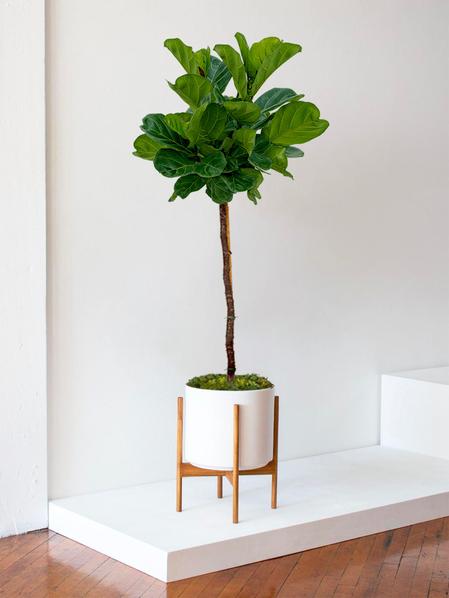
Questions about the Fiddle Leaf Fig Tree 1m60 Extra Large Mid-Century
A lush and sculptural plant with elegant violin-shaped leaves, the Fiddle Leaf Fig Tree is the most popular amongst the Fiddle family and makes for a dramatic addition to any indoor space. This plant needs bright indirect light.
What is the 30-day plant guarantee all about?
We want to ensure that everyone has a successful experience with their plants. Our plants are all easy to care for and come with our care instructions to guide you in their care. Even so, if your plant dies within the first 30 days of receipt, we will replace it!
All you have to do is contact us!
Your plants look so perfect in the pictures… Are they real?!
We're often asked if our plants are artificial… We swear they're real!
At Léon & George we do our best to ensure that you get the interior you dream of, without having to run through several stores to find the ideal composition.
Ready to install and to be admired, our houseplants are carefully selected and prepared. They are adapted to your desires and your space. Our green plants are accompanied by edition planters with noble and innovative materials. They will also be accompanied by clay balls (placed between the horticultural pot and the planter to preserve a good rate of humidity), a sophisticated finish thanks to the naturally stabilized moss that covers the potting soil and our maintenance advice.
Will the plant I receive be exactly like the one in the photo on your site?
Of course, no two plants look the same. Although we do our best to offer you a plant that looks as much as possible as the photos, there will always be variations, which is what makes each plant unique!
How do I choose the right plant for me?
Léon & George specializes in delivering plants adapted to modern life.
Forget complicated care, our plants are handpicked for their resilience and ease of maintenance. Nevertheless, it's crucial to consult the specific requirements and care guide for each variety. You'll find advice on sunlight, watering and other care tips tailored to your new green friend.
A few questions to ask yourself:
Do I already have experience with plants? Easy-care plants
Do I go away regularly?
What's the exposure of my apartment and how bright is my space? Consult our light guide.
Do I have pets or a young child? Non-toxic plants.
Don't hesitate to consult our different collections, which will meet every need and every space.
Are you still in a botanical fog? Don't panic! Our team of botanical experts is just a click away. Simply send us your questions to [email protected] and we'll help you find the perfect plant for your space.
Where can I buy indoor plants online?
Léon & George lets you buy indoor plants online, hand-picked and delivered ready to display in their pot. Every plant is guaranteed for 30 days.
Where do you deliver your indoor plants?
We deliver across Europe, including France, Belgium and Luxembourg: see covered cities. For delivery in the United States, visit leonandgeorge.com.
Can fiddle leaf fig trees be grown outdoors?
Fiddle Leaf Fig trees (Ficus lyrata) are tropical plants that are native to the rainforests of West Africa. They receive bright, indirect sunlight and high humidity in their natural habitat. While it is possible to grow a fiddle leaf fig tree outdoors in certain climates, they are generally best suited for indoor cultivation in pots or containers. Fiddle Leaf Fig trees can be grown outdoors in warmer climates where the temperature stays above freezing, but they require a location with bright, indirect sunlight and high humidity. They also need to be protected from strong winds and direct sunlight, which can scorch their leaves. If you live in a cooler climate and want to grow a fiddle leaf fig tree outdoors, it is best to keep it in a container that can be brought indoors during the winter months to protect it from frost. It is important to remember that Fiddle Leaf Fig trees are not as hardy as some other types of trees and may be more prone to pests and diseases when grown outdoors. Maintaining the ideal temperature and humidity levels for these plants outdoors is also more challenging, which can affect their growth and overall health.
How big do fig trees get?
Fiddle leaf fig trees (Ficus lyrata) are a popular indoor houseplant known for their large, glossy leaves. When grown indoors, these trees typically reach a height of 1m80 - 3m, although they can potentially grow taller if provided with adequate care. The size of a fiddle leaf fig tree can also depend on the size of the pot or container it is grown in. If the pot is too small, the tree may become root-bound and unable to grow to its full potential. It is a good idea to repot your fiddle leaf fig tree into a slightly larger pot every two to three years to give the roots more room to grow and to provide the plant with fresh soil.
How do I know when it's time to repot my fiddle leaf fig tree?
There are a few signs that can indicate it's time to repot your fiddle leaf fig tree:
- The roots are visibly overcrowded in the current pot: If the roots are tightly packed, and there is no longer room to grow, it may be time to repot your fiddle leaf fig tree into a larger pot.
- The plant is not growing or is growing very slowly: If your fiddle leaf fig tree is not growing or is growing very slowly, it may be because the roots are too crowded or the soil is no longer providing enough nutrients. In this case, repotting the plant into fresh soil may help stimulate new growth.
- The plant is top-heavy: If your fiddle leaf fig tree has become top-heavy and is tipping over, it may be necessary to repot it into a larger pot to provide more support.
- The pot has become too small: If the pot that your fiddle leaf fig tree is in is too small, the roots may not have enough room to grow and the plant may become root-bound. In this case, it's time to repot the plant into a larger pot.
In general, it is a good idea to repot your fiddle leaf fig tree every two to three years to provide fresh soil and give the roots more room to grow. When repotting, use a pot that is slightly larger than the current pot, as fiddle leaf fig trees do not like to be overpotted. Choose a pot with good drainage to prevent excess moisture from accumulating in the soil.
Does the Fiddle-Leaf Fig purify the air?
Like many large tropical foliage plants, the Fiddle-Leaf Fig (Ficus lyrata) helps freshen the air in your home. Through photosynthesis it absorbs carbon dioxide and releases oxygen, and its broad leaves offer a large surface that can help filter some common indoor pollutants such as formaldehyde and benzene. That said, it is grown above all for its sculptural foliage, so cleaner air is a welcome bonus rather than its main job.
Does the Fiddle-Leaf Fig need a lot of light?
Yes, more than most houseplants. The Fiddle-Leaf Fig (Ficus lyrata) loves bright, indirect light and is happiest close to a luminous window. Give it as much natural light as possible, but avoid harsh direct midday sun, which can scorch its large leaves. Unlike more tolerant plants, it does not do well in shade or low light, where it tends to stall, drop its lower leaves and lean toward the nearest light source. Rotating it from time to time helps it grow evenly.
Is the Fiddle-Leaf Fig easy to care for?
The Fiddle-Leaf Fig (Ficus lyrata) is rewarding but a little more particular than some houseplants: it thrives on consistency. Once you find it a bright spot, leave it there, as it dislikes being moved, draughts and sudden temperature changes. Water moderately and let the surface of the substrate dry out between waterings, since it is especially sensitive to excess water. With a stable location, steady bright light and careful watering, it stays healthy and handsome.
Is the Fiddle-Leaf Fig prone to disease and parasites?
The Fiddle-Leaf Fig (Ficus lyrata) can be attacked by red spider mites and scale insects. Inspect its foliage regularly, and if you spot them, remove the pests with Super Neem Oil solution and a soft cloth, then mist the leaves more often to raise humidity.
It is also sensitive to a lack of light, excess water and draughts. Under stress its leaves may yellow, develop spots and eventually drop. If this happens, adjust your watering, move it closer to a source of natural light and keep it away from cold draughts.
Dark brown spots, often spreading from the centre or base of the leaf, can signal overwatering or root rot. Make sure you are not watering too often, that no water sits at the bottom of the pot, and treat the plant with the Essential Plant Repair Care Pack.
Is the Fiddle-Leaf Fig toxic or poisonous to humans or pets?
The Fiddle-Leaf Fig (Ficus lyrata) is considered toxic, so take care around pets and young children. Its sap can irritate the skin and mouth, and if eaten the leaves may cause irritation and digestive upset. Keep it out of reach of curious animals and children.